Fujifilm X-T5. A 23mm Prime. Melbourne's Backlit Streets.
Dam brought a Fujifilm X-T5 with a 23mm f/2.0 lens and an eye for light. This is what happened in 3 hours on the streets of Melbourne.
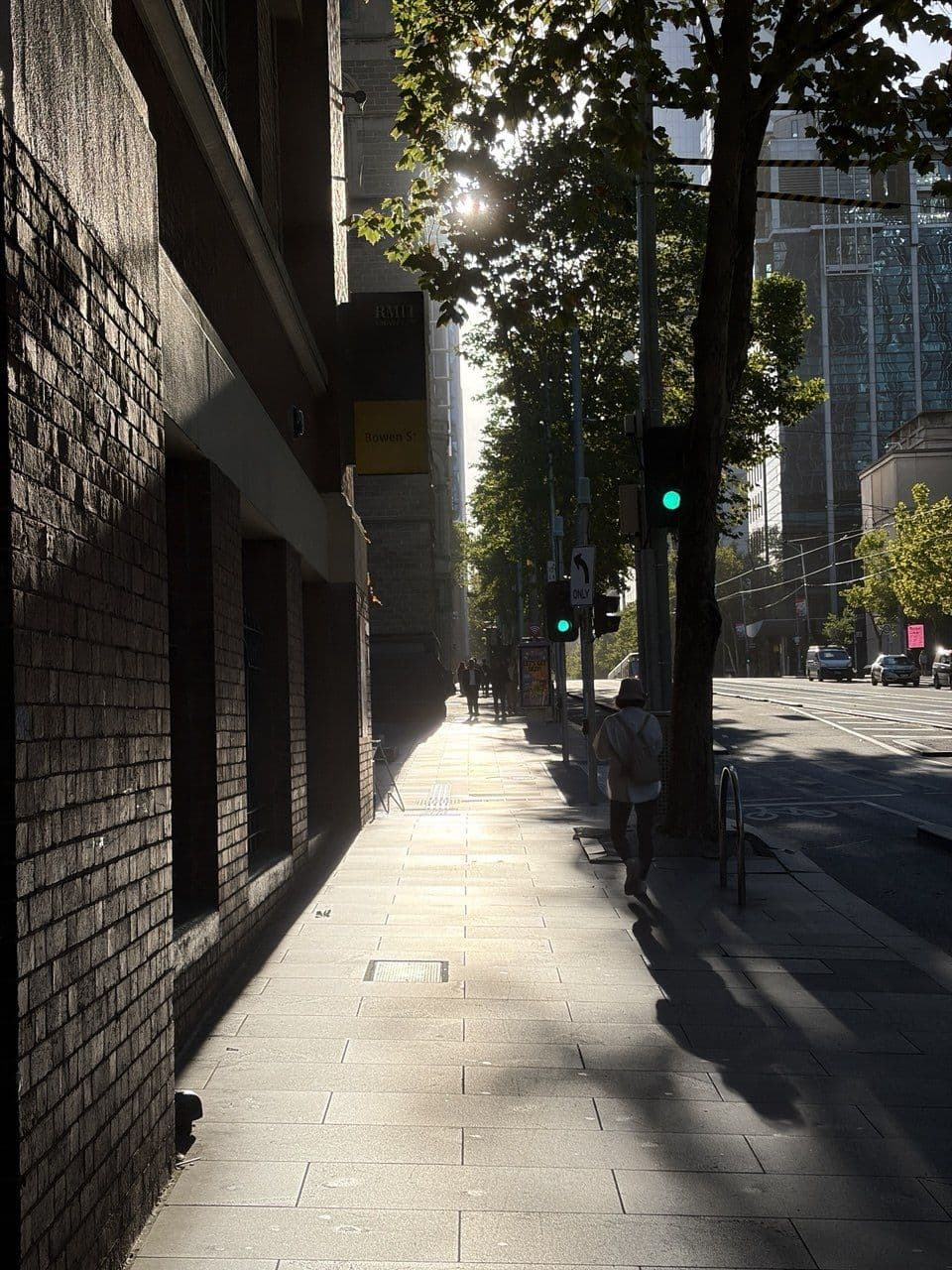
Backlit sidewalk, Melbourne CBD. Dam was shooting this scene on his Fujifilm X-T5 with the 23mm f/2.0.
The Setup: Fujifilm X-T5 + 23mm f/2.0
Dam showed up with a Fujifilm X-T5 and a 23mm f/2.0 prime lens. The X-T5 still has physical dials on top of the body for shutter speed, ISO, and exposure compensation. No menus. You turn a dial, the setting changes. It sounds like a small thing until you're standing on a street corner trying to adjust three variables at once.
The 23mm on Fuji's crop sensor gives you roughly 35mm equivalent, which is the classic street focal length. Wide enough to get the scene in, tight enough that faces don't stretch at the edges. At f/2.0 it lets in plenty of light, which matters when you're shooting straight into backlight and the shadows go deep. Dam had the right gear already. What he was missing was the manual mode fundamentals to tie it together.
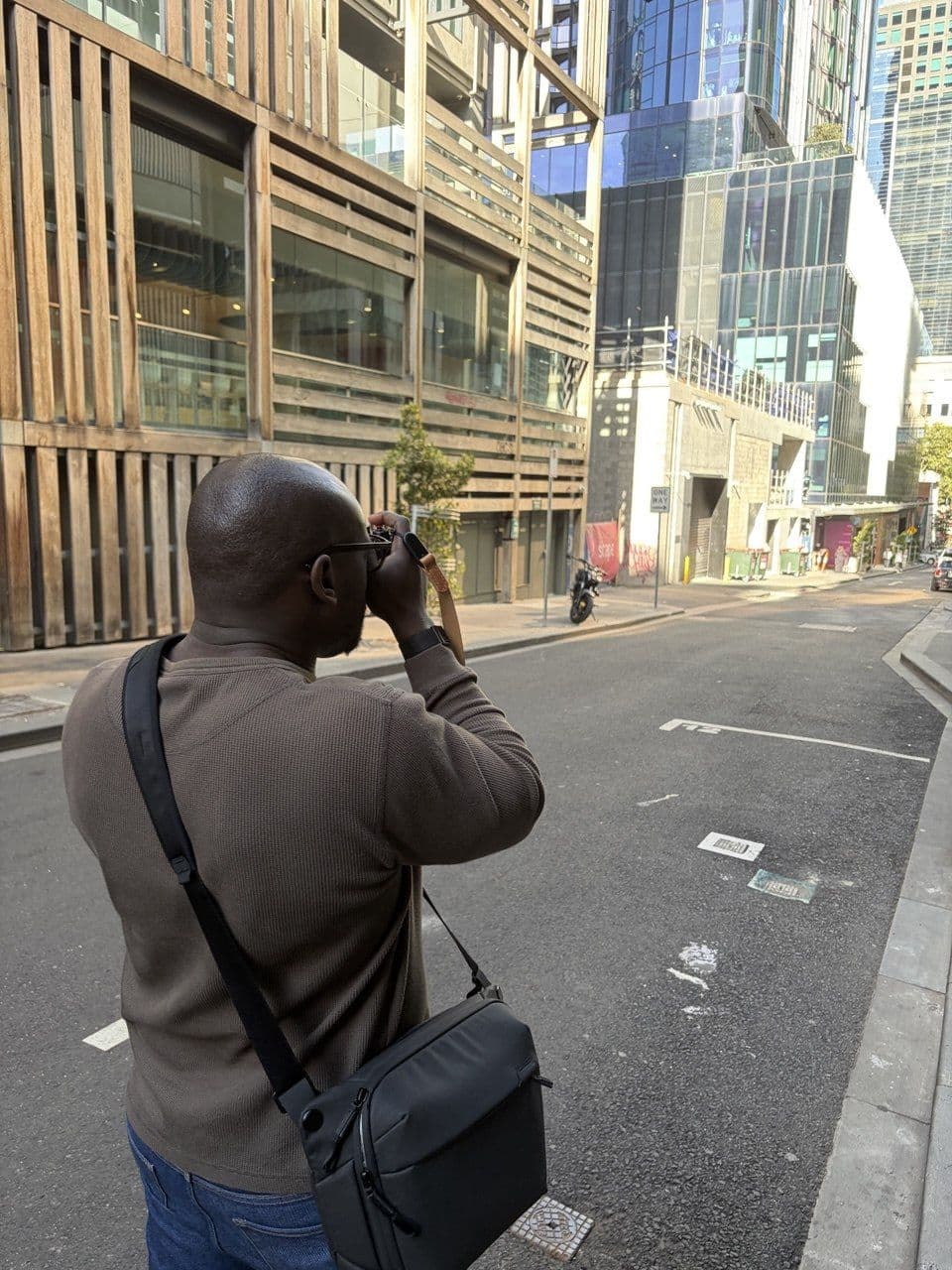
Dam lining up a shot with his Fujifilm X-T5 in Melbourne CBD.
Light and Shadow: Reading the Scene
Most people walk past good light without seeing it. Dam didn't. That backlit sidewalk shot at the top of this page - he saw it straight away. The lines converging down the footpath, the green traffic light punching through, trees framing both sides. He was already positioning himself. The problem was he had no idea how to expose for it.
Backlight is tricky to meter. The camera sees a bright light source and wants to darken the whole frame. We spent time with the X-T5's exposure compensation dial and the histogram, pushing the exposure up so the shadows stay readable and the highlights blow out just enough to look like real backlight instead of a grey mess. There's no formula for it. You just learn to read the histogram and trust your eyes. The X-T5 helps here because the exposure comp dial is right there on top - you can ride it while you walk without looking down.
Shutter speed matters too. At 23mm you can handhold 1/125s comfortably, but when you're pushing exposure for backlight, the temptation is to slow the shutter down. Bad idea on a busy street. Better to bump the ISO. The X-T5's APS-C sensor is clean at 3200 and still usable past that. By the second half of the session, Dam was making that call without hesitating.
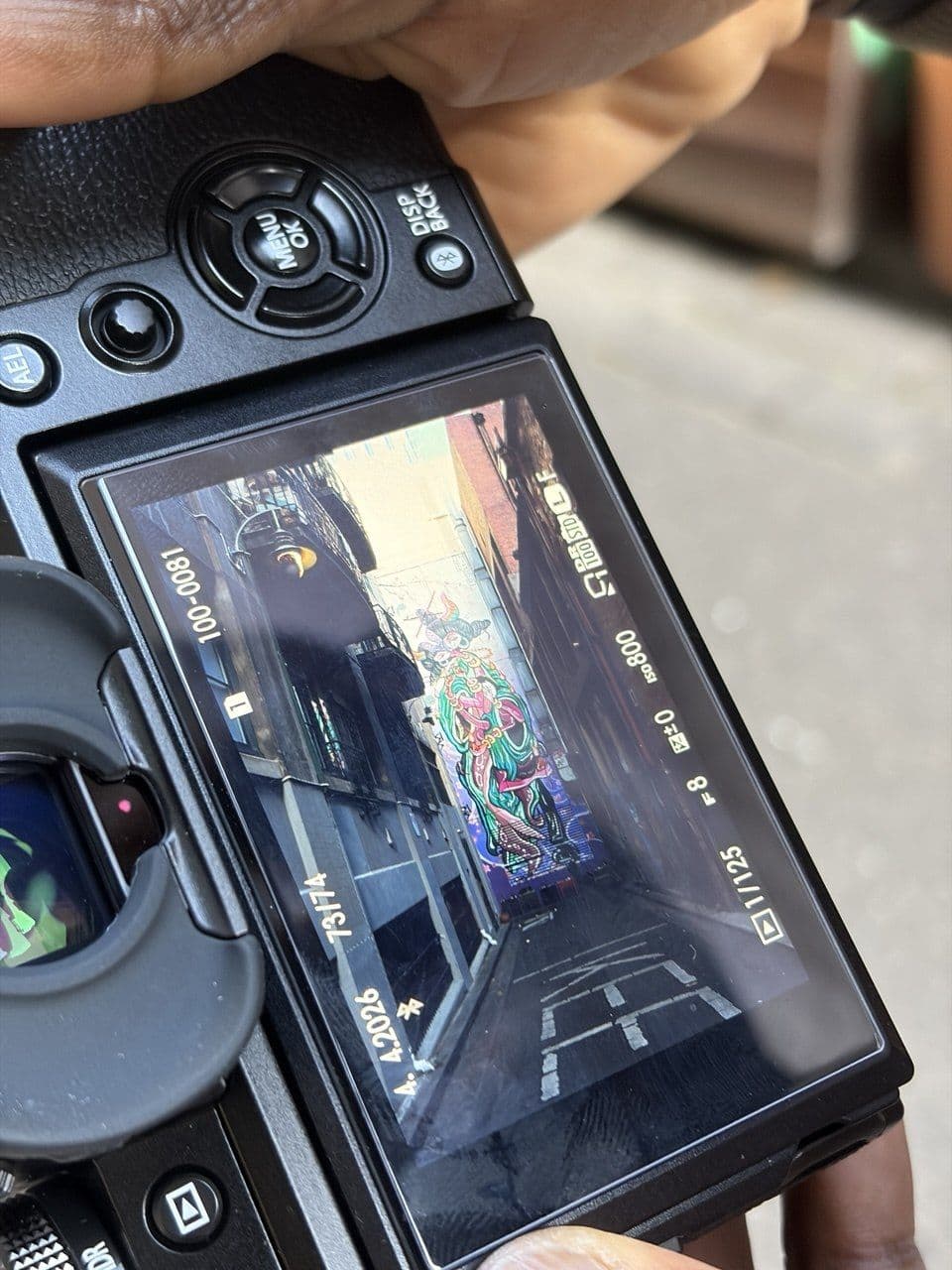
Checking the composition on the X-T5's rear LCD. Colourful laneway, full manual.
Why the X-T5 Is Built for Learning
Most modern mirrorless cameras bury their settings in menus or assign them to unlabelled command dials that do different things depending on what mode you're in. The X-T5 doesn't do that. Shutter speed dial on top. ISO dial on top. Aperture ring on the lens. You can look at the camera switched off and read all three settings.
For learning, that's a big deal. "Drop your shutter speed to 1/60" - Dam just looked at the dial and turned it. No holding buttons, no scrolling through menus. It feels like using a film camera, and it makes the one-setting-at-a-time method click straight away.
The 23mm f/2.0 pairs well with it. Small enough to carry all day, sharp, and fast to focus. If you shoot Fuji and want one lens to learn street photography on, the 23mm is hard to argue with.
Fujifilm X-T5 Photography Course: Quick Answers
Is the Fujifilm X-T5 good for street photography?
It's genuinely good for it. The physical dials mean you can change settings fast without diving into menus, and the body is small enough that you don't look like a tourist lugging a massive camera around. Stick a 23mm f/2.0 on it and you've got a proper street setup.
Can you learn manual mode with a Fujifilm camera?
Fuji's dial layout helps. The X-T5 has real dials for shutter speed and ISO, plus an aperture ring on the lens. You can see where every setting is without turning the camera on. Dam went from auto to full manual in one session. The physical controls make that jump less abstract.
What lens should I use for street photography on Fujifilm X-T5?
The 23mm f/2.0 is hard to beat. It gives you a 35mm equivalent on the X-T5's APS-C sensor, which is the classic street focal length. It's small, sharp, and fast to focus. Wide enough for scene-setting shots, tight enough that faces don't distort at the edges. Dam used it for the entire session.
How much is the photography course?
$499. Three hours in Melbourne CBD with Daniel Bilsborough. Max 2 students so you actually get proper attention. Bring any camera that has a manual mode.
What Dam Learned
- Backlight? Push the exposure comp up. Let the highlights blow. Save the shadows.
- The X-T5's physical dials mean you can change settings without taking your eye off the street
- 23mm on crop sensor = 35mm equivalent, the classic street photography focal length
- Don't be scared of ISO - the X-T5 is clean at 3200 and usable past that
- Where the light falls matters more than what your settings are
Dam could already see good light. He just couldn't tell his camera what to do with it. Three hours later, he could. That's the course. No classroom, no theory slides. Just you, your camera, and the streets of Melbourne until it clicks. See how Joseph did the same thing with a Canon R8, or how Janet went from auto to manual on a Canon R100.
Your Turn
The DSLR & Mirrorless Express Photography Course runs every Saturday in Melbourne CBD. Max 2 students. $499. Check our photography tips for beginners if you want a head start before you come.