Gear Guide
Best Camera for Beginners
Brain dump from Daniel, July 2026. Founder of the DJB Photography School.
My number one recommendation is to get yourself a full-frame camera, either brand new or second hand. One of the best value buys on the second-hand market is the Nikon Z6, the original one. Or honestly any full-frame camera of that era, like the Sony a7 III, Canon EOS R, or Canon 5D Mark IV. I shoot the Z6 myself. Nikon doesn't pay me to say this, I just like their cameras.
Why full frame? Mainly so you can use the pro lenses at the focal length they're designed for, plus you get the 35mm sensor. A full-frame sensor is the same size as a 35mm piece of film, so you get to experience the glory of 35mm. If your budget is smaller, just get the biggest sensor you can, so your photos step away from what a phone already does well. There's a point where you may as well use your phone, which is why I suggest full frame first. When I started out there wasn't much of a used full-frame market. These days there are plenty of great-value options.
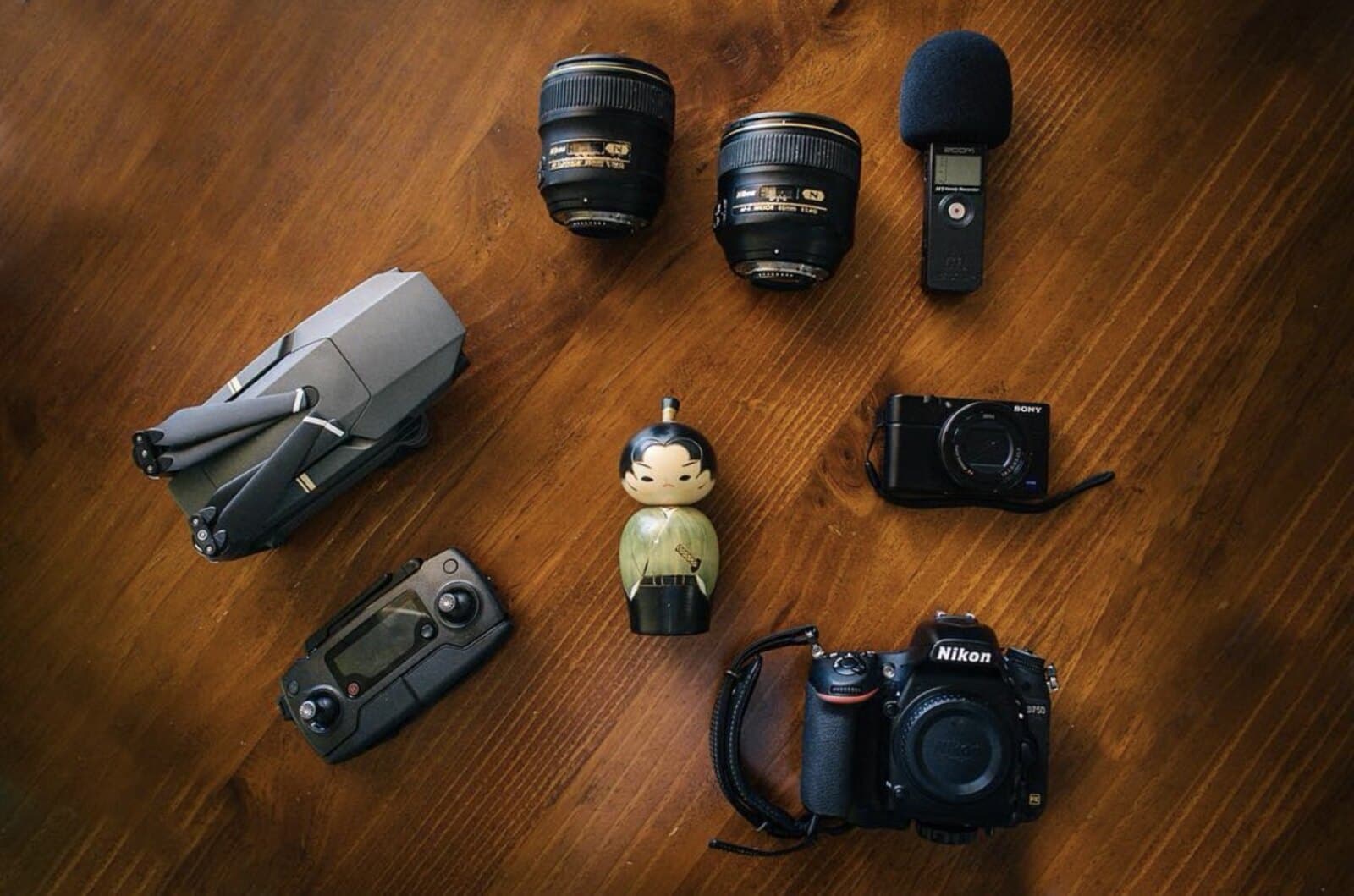
Part of Daniel's own kit.
Daniel's Philosophy on Choosing Your First Camera
Your perfect first camera is unique to you. Tune in to what you're drawn to, that's it. It doesn't matter what's “sensible”. Sometimes the perfect camera is the one that doesn't make sense.
Features Worth Looking For
- ■Manual mode. This is the one that really matters. You want full manual control (an M on the mode dial) so you can take the camera off auto when you're ready. The good news is almost every interchangeable-lens camera has it, so it's more of a quick thing to check than a dealbreaker.
- ■Interchangeable lenses. The kit lens will take you a long way to start with. What's nice is that later on you can add something like a 50mm f/1.8 for a whole new look, all without buying a new camera.
- ■RAW shooting. JPEG quietly throws away a lot of what your sensor captured. RAW keeps it all, which gives you far more room to play when you come to learn Lightroom or any editing software.
- ■Comfortable in your hands. You'll be holding this for a few hours at a time, so how it feels really matters. If a camera feels awkward in the shop, it'll feel worse on a walk, so pick the one that feels right to you.
Camera Sensor Sizes, Explained Simply
Sensor size is the bit of jargon that trips up most beginners, so here's the whole story in plain English. Back in the film days, the standard film was 35mm wide. That was simply what most cameras used, and every photo was that size.
When digital cameras came along, a big sensor was expensive to make, so most cameras used a smaller, cheaper one, known as a crop sensor. Later, when the technology caught up and cameras could fit a sensor the same size as that old 35mm film, the name stuck: full frame. The rest are just steps up and down from there, sorted below from smallest to biggest.
- Phone sensorThe smallest
Amazing for how small it is, but that tiny sensor is why phones struggle in low light and can't blur a background like a bigger camera can.
- Micro Four ThirdsA step up from a phone
Bigger than a phone sensor, and small enough to keep the camera and lenses really compact. The step between your phone and APS-C.
Examples: OM System OM-5, Panasonic Lumix G9, Olympus OM-D E-M10
- APS-CThe popular crop sensor
Bigger again, and where most beginner cameras land. Smaller, lighter, and cheaper than full frame, but genuinely capable.
Examples: Sony a6400, Fujifilm X-T30 II, Nikon Z50
- Full frameThe old 35mm film sizeWhere Daniel points beginners
The size Daniel shoots himself. Handles low light well and works with the pro lenses.
Examples: Nikon Z6, Sony a7 III, Canon EOS R
- Medium formatBigger than full frame
A sensor bigger than full frame, with fine detail and smooth tonality. Big, expensive, and the largest sensor most photographers ever handle.
Examples: Fujifilm GFX 50S, Hasselblad X1D, Pentax 645Z
The short version: a bigger sensor gathers more light, which is why it handles dim conditions better and gives you that soft, blurry background. Bigger also means heavier and pricier. A bigger sensor doesn't always mean better photos, but it does mean you'll have a different photography experience.
DSLR vs Mirrorless for Beginners
Mirrorless is where the industry is now. Every major manufacturer has moved to mirrorless. New lens development, firmware updates, and innovation are all happening on mirrorless platforms. DSLRs still take very good photos.
Used DSLRs are good value. A second-hand Nikon D7200 or Canon 80D for A$400-600 is a lot of camera. The image quality is excellent, they're built like tanks, and there are decades of cheap lenses available.
For a beginner deciding between the two, the image quality is close enough that it won't be what decides it. Mirrorless wins on size, live preview, and where the lenses are heading; a used DSLR wins on price. New bodies today are almost all mirrorless, while the best DSLR value sits on the used market. Which way you go is your call.
The First Lens to Buy After the Kit Lens for a 35mm Full Frame Camera
A 50mm f/1.8 (or the equivalent for your sensor size). Every brand makes one, they cost A$100-250, and they completely change how your photos look.
The wide f/1.8 aperture gives you that creamy, blurred background (bokeh) that makes portraits pop. It also lets in far more light than your kit lens, which means better performance in dim conditions and night photography. It's sharp and fast, and it doesn't cost much.
Used Cameras Worth Considering
Here's the used market laid out simply. There are two generations to choose from, each grouped by sensor size. Generation 1 is the value sweet spot; Generation 2 is a step newer for a bit more money. If you'd rather buy brand new, the current generation of each line is listed at the bottom, with what each of those bodies currently fetches used alongside it. Tap any camera to see the detail and an approximate Australian used price.
Prices last checked September 2026
Rough guides for used bodies (no lens); they shift with condition and stock.
Where the numbers come from: every couple of months I check what Australian used dealers are asking (Ted's, Georges, Camera Electronic, digiDirect and CameraPro), what private sellers are asking on Gumtree and eBay Australia, and what eBay Australia listings have actually sold for. The used range runs from a typical private price up to what a dealer charges with a warranty. New prices are the going street price at those same dealers plus the Hasselblad Australia store, so a one-day sale won't skew them.
Generation 1
2016 - 2019The value sweet spot. First-wave used full frame and the crop bodies of the same era, now at their friendliest prices.
Full frame
Nikon Z6Daniel's pick2018A$800 - A$1,300
Daniel's own camera, and his top pick here. A 24-megapixel full-frame body with in-body stabilisation that shines in low light and feels lovely with good lenses. It uses pricier XQD/CFexpress cards and the autofocus is a generation behind the newest bodies, but for the money used, it's hard to beat.
Sony a7 III2018A$900 - A$1,400
The camera that made full frame mainstream. Fast, reliable autofocus, long battery life, and a huge choice of lenses. Still one of the most capable cameras at this price, and easy to find used.
Canon EOS R2018A$900 - A$1,250
Canon's first full-frame mirrorless, and often the cheapest way into full frame. Gorgeous colour straight out of camera and comfortable to hold. A single card slot and older autofocus, but a lot of camera for the money.
Canon 5D Mark IVDSLR2016A$900 - A$1,600
A workhorse DSLR that professionals shot for years. Superb image quality, tank-like build, and decades of affordable Canon lenses to draw on. Bigger and heavier than mirrorless, but wonderful value if you don't mind an optical viewfinder.
APS-C
Sony a64002019A$700 - A$950
A compact crop-sensor camera with quick autofocus and a flip-up screen. Light to carry all day and an easy first 'proper' camera when full frame is out of budget.
Fujifilm X-T30 II2021A$950 - A$1,150
Beautiful film-simulation colours and proper physical dials that make learning manual mode feel natural. Small, stylish, and a joy to carry. Used stock moves around, so treat the price as a ballpark.
Nikon Z502019A$600 - A$850
Nikon's friendly little crop-sensor mirrorless. Comfortable grip, simple menus, and image quality that holds up for the price. A gentle, capable place to start, though used and clearance prices overlap, so it's worth shopping around.
Medium format
Fujifilm GFX 50S2017A$1,900 - A$2,800
Your cheapest realistic way into medium format. A 51-megapixel sensor bigger than full frame, with breathtaking detail and tonality. Slow and deliberate to shoot, and a rewarding thing to explore whenever you feel drawn to it. Body-only stock is scarce in Australia, so treat the price as a rough guide.
Generation 2
2020 - 2023A step newer. Better autofocus and video, and still strong used value, for a bit more money.
Full frame
Nikon Z6 II2020A$1,250 - A$1,800
The Z6 with two card slots, faster processing, and improved autofocus. All the little things people wanted from the original, for a bit more.
Sony a7 IV2021A$1,800 - A$2,600
A big step up: 33 megapixels, autofocus that tracks well, and video to match. It holds its value, so it's the priciest here, but it's a camera you could happily shoot for a decade.
Canon EOS R62020A$1,400 - A$1,900
Canon's do-everything full-frame body, with fast autofocus, plenty of headroom in low light, and a comfortable feel in the hand. Used prices have eased now that the Mark II and the Mark III are both out.
Canon EOS R6 Mark II2022A$1,900 - A$2,650
The R6 with a 24-megapixel sensor, sharper autofocus, and better battery life. It has been turning up on the used market since the Mark III arrived.
APS-C
Sony a67002023A$1,400 - A$1,800
Sony's most capable crop-sensor camera: sharp autofocus, in-body stabilisation, and solid video in a small body. A serious little all-rounder.
Fujifilm X-T52022A$1,650 - A$2,050
40 megapixels of detail, the colours Fuji is known for, and the classic dials. Beloved by photographers who want a camera that's a pleasure to use. It holds its value, so used bargains are rare.
Canon EOS R72022A$1,300 - A$1,600
Canon's enthusiast crop body, with fast burst shooting and dependable autofocus. A strong pick if you like the Canon feel and want a little extra reach from your lenses.
Medium format
Fujifilm GFX 100S2021A$4,200 - A$5,100
102 megapixels of medium-format detail with in-body stabilisation, in a body barely bigger than a full-frame camera. Extraordinary image quality and, used, a fraction of its launch price. Pure indulgence, and good to know it exists.
Current Generation
Buy newIf you'd rather buy brand new, this is the latest version of each line, with what it currently fetches used underneath. You pay more than used, but you get the newest autofocus, video, and full warranty.
Full frame
Nikon Z6 III2024A$3,500Used A$2,600 - A$3,200
The newest Z6, and the current version of Daniel's own camera. Faster processing, a brighter viewfinder, and much-improved autofocus over the original.
Sony a7 V2025A$4,300Used A$3,400 - A$3,800
Sony's current mainstream full-frame body, announced in December 2025. A 33-megapixel partially stacked sensor, with quicker autofocus and faster bursts than the a7 IV before it. Used copies are only just starting to turn up in Australia, so treat the used figure as a rough guide for now.
Canon EOS R6 Mark III2025A$3,450Used A$3,000 - A$3,250
Canon's current mainstream full-frame body, announced in November 2025. Improved autofocus and video over the Mark II, with the same comfortable feel in the hand. Used copies are only just starting to turn up in Australia, so treat the used figure as a rough guide for now.
APS-C
Sony a67002023A$2,100Used A$1,400 - A$1,800
Sony's current top crop-sensor camera: brilliant autofocus, in-body stabilisation, and video to match, in a small, light body.
Fujifilm X-T5Discontinued2022A$2,300Used A$1,650 - A$2,050
Fujifilm discontinued the X-T5 in the middle of 2026 and there's no X-T6 announced yet, so new stock is whatever dealers still have on the shelf. 40 megapixels, the classic Fuji dials, and a camera that's a genuine pleasure to use. This entry gets updated when the X-T6 lands.
Fujifilm X-T30 III2025A$1,500Used A$1,050 - A$1,250
Fuji's current small beginner body, announced in October 2025. The same film simulations and physical dials as the X-T30 II, with a newer processor and autofocus. Used copies are only just starting to turn up in Australia, so treat the used figure as a rough guide for now.
Nikon Z50 II2024A$1,550Used A$1,000 - A$1,400
The newest version of Nikon's friendly little crop-sensor mirrorless. Faster, smarter autofocus, and an easy first proper camera bought new.
Medium format
Fujifilm GFX 100S II2024A$7,900Used A$5,700 - A$6,500
The current entry into medium format: 102 megapixels of detail in a body barely bigger than a full-frame camera. Pure indulgence, and good to know it exists.
Medium Format: Fuji vs Hasselblad
Medium format is the one place in this guide where I quote a lens price on top of the body, because here the lens is a big slice of the entry cost and it swings a lot between systems, so the body price on its own would mislead you.
Medium format digital these days means a 44 by 33mm sensor (both the Fujifilm GFX and Hasselblad X bodies use the same one), about 1.3 times bigger than full frame, a real but modest step up. Because of that sensor size the focal lengths shift a little: the classic fifty-millimetre “nifty fifty” look comes from a 63mm lens on Fuji and a 65mm on Hasselblad, both f/2.8, which works out to roughly a 50mm f/2.2 in full-frame terms.
To keep it fair, here is each system three ways: the latest model bought brand new, and two earlier generations bought secondhand with a used lens.
Brand new
Latest modelSecondhand
Second generationSecondhand
First generationBuying new
Bodies. The Fujifilm GFX 100S II is A$7,900, with modern autofocus, video, and Fuji's wide lens range. The Hasselblad X2D II 100C is A$12,300 for the body alone, where the extra money goes to its colour rendering and leaf shutter. Used X2D II bodies are only just appearing, at around A$11,000. Both are around 100 megapixels.
Lenses. The Fujifilm GF 63mm f/2.8 is A$2,000. The Hasselblad XCD 65mm f/2.8 has no Australian distributor any more as of September 2026: stock ran out in mid 2025 and was never replaced. Hasselblad still makes it and still sells it overseas, and used copies turn up here at about A$3,000. The Hasselblad lenses Australian dealers stock now are the newer 55mm f/2.5 V at A$6,445 and the 75mm f/3.4 P.
Buying secondhand
Bodies. Secondhand is the affordable way into medium format. A used Fujifilm GFX 50S is about A$2,500 and a used Hasselblad X1D II 50C about A$3,600. Both drop to 50 megapixels with slower autofocus and older screens, but the files still hold enormous detail. Step up to a second-generation used body, a Fujifilm GFX 100S or Hasselblad X2D 100C, and you get the full 100 megapixels for more.
Lenses. The same two lenses turn up used, roughly A$1,250 for the Fujifilm GF 63mm f/2.8 and A$3,000 for the Hasselblad XCD 65mm f/2.8. Which system is for you is entirely your call.
All prices here are in Australian dollars, and secondhand prices move with what's in stock, so treat them as a guide.
Free calculators
To compare sensor sizes and lenses before buying, use the crop factor and field of view calculator and the depth of field calculator.
Once You've Got Your Camera
Daniel Bilsborough's photography course in Melbourne teaches you to shoot in full manual mode in a single 3-hour session. Bring whatever camera you own. The rest of the photography guides cover manual mode, light, and composition.