Free photography tool
Field of View and Crop Factor Calculator
Pick a sensor and a lens to see its angle of view, how it compares on full frame, and how much of the scene it takes in, drawn over a Melbourne skyline.
A 35mm lens on an APS-C sensor sees 37.1° across and frames like 54mm on full frame. At 10.0 m it takes in a scene 6.71 m wide.
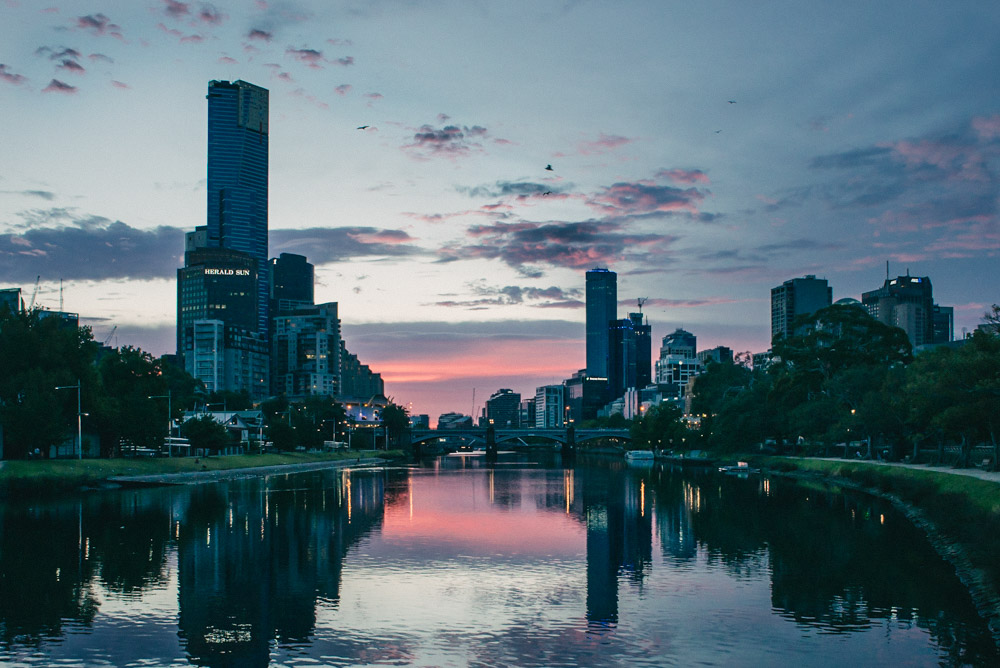
Illustration: the whole photo stands in for a 14mm view on full frame.
How to use the field of view calculator
- Choose your sensor. The crop factor appears in the results straight away.
- Enter the real focal length from the lens, or tap a common one: 16, 24, 35, 50, 85, 135 or 200mm.
- Set the aperture to see its full-frame equivalent for depth of field.
- Set a distance to see how wide and tall a scene the lens takes in at that distance, for example a building across the street or a group of people.
The red box on the photo is your lens. The white boxes show 24, 35, 50 and 85mm on full frame for comparison. The whole photo stands in for a 14mm view on full frame.
Crop factor and full-frame equivalents
| Sensor | Size | Crop factor | 50mm frames like |
|---|---|---|---|
| Medium format (GFX, Hasselblad X) | 44 x 33 mm | 0.79 | 39mm |
| Full frame | 36 x 24 mm | 1.0 | 50mm |
| APS-C (Sony, Nikon, Fujifilm) | 23.5 x 15.6 mm | 1.53 | 77mm |
| APS-C (Canon) | 22.3 x 14.9 mm | 1.61 | 81mm |
| Micro Four Thirds | 17.3 x 13 mm | 2.0 | 100mm |
| 1-inch | 13.2 x 8.8 mm | 2.73 | 137mm |
Crop factor matters most when choosing a lens. A 35mm prime on APS-C frames like about 54mm on full frame, a classic "normal" view. If you are still choosing a body, the best camera for beginners guide covers full frame, APS-C and Micro Four Thirds options side by side.
Worked example: framing the same shot on three cameras
To match the view of a 50mm lens on full frame, which covers 39.6 degrees across, you need about 33mm on Sony, Nikon or Fujifilm APS-C and 25mm on Micro Four Thirds.
A 35mm lens on APS-C is close: 37.1 degrees across, framing like 54mm on full frame. Standing 10 m from a building, it takes in a scene about 6.7 m wide and 4.5 m tall. A 24mm lens on full frame at the same spot takes in 15 m by 10 m, enough for the whole facade and the footpath in front of it.
The background blur changes too. f/1.8 on APS-C gives roughly the depth of field of f/2.8 on full frame for the same framing, and f/1.8 on Micro Four Thirds is closer to f/3.6. The depth of field calculator shows the exact near and far limits for each.
Choosing a focal length
| Full-frame focal length | Horizontal angle | Typical use |
|---|---|---|
| 16mm | 96.7° | Interiors, big skies, tight laneways |
| 24mm | 73.7° | Landscapes, architecture, wide street scenes |
| 35mm | 54.4° | Street and documentary, environmental portraits |
| 50mm | 39.6° | Everyday photos, half-length portraits |
| 85mm | 23.9° | Head and shoulders portraits |
| 200mm | 10.3° | Sport, wildlife, compressed city views |
A zoom covers several of these in one lens. Michael's Nikon Z6 II and 28-400mm session shows what that range does on Melbourne's streets, and Eliza's Fujifilm X-S20 kit lens story covers a 15-45mm on APS-C.
How it is calculated
- Angle of view:
2 × arctan(d / 2f), where d is the sensor width, height or diagonal and f is the focal length - Crop factor:
43.27 mm / sensor diagonal - Scene width at distance D:
sensor width / f × D - Equivalent focal length and aperture: multiply each by the crop factor
These assume a rectilinear lens focused at infinity, which covers nearly all photography lenses apart from fisheyes. The framing overlay scales each box against a 14mm full-frame view. Everything runs in your browser, nothing is uploaded, and there is no sign-up.
Common mistakes
- Applying crop factor twice. Lenses are marked with their real focal length. Some phone and compact makers quote the equivalent instead, so check which one you have.
- Assuming crop factor changes exposure. It changes framing and depth of field. f/2.8 is f/2.8 for exposure on every sensor, as the exposure calculator shows.
- Forgetting the aspect ratio. Micro Four Thirds is 4:3, so it covers relatively more height than a 3:2 sensor.
Frequently asked questions
What is the field of view of a 50mm lens?
On a full-frame camera a 50mm lens covers about 39.6 degrees horizontally, 27 degrees vertically and 46.8 degrees diagonally. On a Sony, Nikon or Fujifilm APS-C camera the same lens frames like about 77mm on full frame, with a horizontal angle of about 26 degrees.
What is crop factor?
Crop factor compares a sensor's diagonal with full frame's 43.3 mm diagonal. APS-C from Sony, Nikon and Fujifilm is about 1.5, Canon APS-C about 1.6, Micro Four Thirds 2.0 and a 1-inch sensor about 2.7. Multiply a lens's focal length by the crop factor to find the full-frame focal length with the same framing.
Does a crop sensor make a lens longer?
The lens itself does not change. A smaller sensor records a smaller part of the image the lens projects, so the photo looks like it was taken with a longer lens. It is the same as cropping the middle out of a full-frame photo.
What is equivalent aperture, and does it change exposure?
Equivalent aperture is the f-number multiplied by the crop factor. It tells you the depth of field and background blur you would get on full frame for the same framing: f/1.8 on APS-C behaves like about f/2.8 on full frame. It does not change exposure. f/1.8 lets in the same light per area on any sensor.
Is angle of view the same as field of view?
Photographers use the terms almost interchangeably. Strictly, angle of view is the angle the lens and sensor take in, in degrees, and field of view is the width of the scene that angle covers at a given distance. This calculator gives both.
Which focal length looks most like human vision?
A full-frame focal length of around 43mm to 50mm is the figure most often quoted, because it gives perspective that feels natural when the photo is viewed at a normal size. The eye's full field of view is far wider than any normal lens.
Why does my lens look slightly different from the calculator?
Angles are calculated for a rectilinear lens focused at infinity. Many lenses frame a little tighter at close focus, an effect called focus breathing, and zoom lenses can be slightly wider or longer than their marked focal length. Fisheye lenses follow different maths.
Learn it with a camera in your hands
Choosing a focal length and seeing what it does to a scene is part of every beginner course. Bring whatever lens you own, kit zoom or prime, and we work with it in full manual through Melbourne's laneways.
The beginner photography course in Melbourne is three hours on foot through the CBD, on your own camera, in full manual, with two students at most. $499.